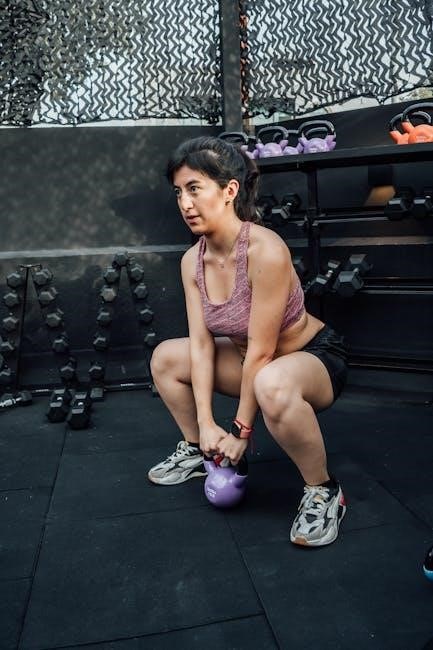
Kettlebell training offers a dynamic, full-body approach, blending strength, cardio, and functional movement – often detailed in comprehensive PDF workout programs.
These programs, like the 30-day swing challenge or 3-week plans, focus on exercises such as swings, Turkish get-ups, and goblet squats for effective results.
Kettlebells are versatile tools, suitable for all fitness levels, and can be incorporated into HIIT routines or core-focused sessions, as outlined in various online resources.
What is a Kettlebell?
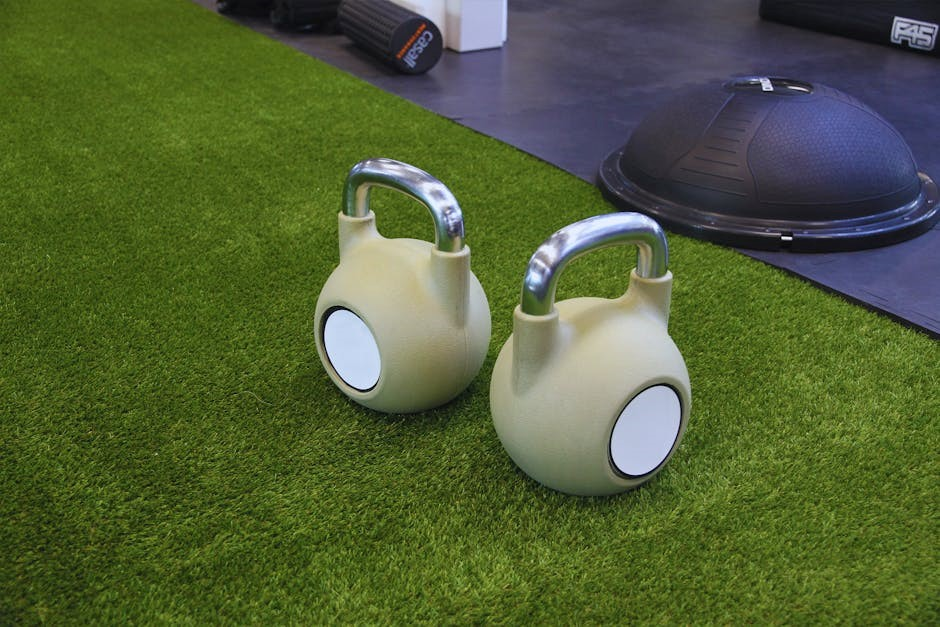
Kettlebells are distinct from traditional dumbbells, characterized by a cast-iron or steel weight featuring a ball-shaped end and a handle. This unique design, often explored in full body kettlebell workout PDF guides, shifts the center of gravity, demanding greater stabilization and engaging more muscle groups simultaneously.
Unlike fixed-weight dumbbells, the kettlebell’s offset weight challenges your core and improves functional strength. Many PDF resources highlight how this design lends itself to dynamic movements like swings and Turkish get-ups. They aren’t just weights; they’re tools for building power, endurance, and balance.
The kettlebell’s versatility allows for a wide range of exercises, making it a staple in many full body workout routines. Its design encourages proper form and efficient movement patterns, often detailed within instructional PDFs.
Benefits of Kettlebell Training
Full body kettlebell workout PDF programs emphasize numerous benefits, starting with improved cardiovascular fitness. Exercises like kettlebell swings are high-intensity, low-impact, boosting heart rate and endurance. Strength gains are significant, targeting multiple muscle groups concurrently – a key focus in many PDF guides.
Beyond strength, kettlebells enhance functional movement, improving real-world activities. Core strength is dramatically improved due to the constant stabilization required, often detailed in PDF exercise breakdowns. Balance and coordination also see substantial gains.
Many PDF resources highlight kettlebell training’s efficiency; workouts are often shorter yet highly effective. They’re also versatile, adaptable to all fitness levels, and require minimal space, making them ideal for home workouts as outlined in various PDF plans.
Kettlebell Safety Considerations
Full body kettlebell workout PDF programs often include crucial safety advice. Proper form is paramount; incorrect technique can lead to injury. Start with lighter weights and master the movements before increasing the load, as emphasized in many PDF guides.
Warm-up routines are essential, preparing muscles and joints for the demands of kettlebell exercises. Adequate space is vital to avoid collisions, a point frequently noted in PDF workout plans. Listen to your body and stop if you experience pain.
Many PDF resources recommend seeking guidance from a qualified instructor, especially when beginning. Ensure a secure grip and controlled movements throughout each exercise. Prioritize technique over weight to minimize risk, a common theme in comprehensive PDF materials.

Warm-up Routine for Kettlebell Workouts
Full body kettlebell workout PDF guides stress the importance of dynamic stretching and joint mobility to prepare muscles, enhancing performance and preventing injury.
Dynamic Stretching
Dynamic stretching is crucial before a full body kettlebell workout, as highlighted in many PDF guides. Unlike static stretches, dynamic movements prepare your muscles for the demands of the workout, increasing blood flow and range of motion.
Effective dynamic stretches include arm circles, leg swings (forward, backward, and sideways), torso twists, and walking lunges with a twist. These movements mimic the actions performed during kettlebell exercises, priming your body for optimal performance.
Focus on controlled movements through a full range of motion, avoiding bouncing or jerky actions. A proper dynamic warm-up significantly reduces the risk of injury and enhances the effectiveness of your kettlebell training session, as detailed in comprehensive workout plans.
Joint Mobility Exercises
Prior to commencing a full body kettlebell workout – often detailed in PDF programs – incorporating joint mobility exercises is paramount. These movements focus on improving the range of motion in key joints like the ankles, hips, shoulders, and spine.
Examples include ankle circles, hip circles, shoulder rotations, and cat-cow stretches. These exercises lubricate the joints, enhance flexibility, and prepare them for the dynamic movements involved in kettlebell training.
Focus on slow, controlled movements, paying attention to any areas of stiffness or restriction. Improving joint mobility not only reduces the risk of injury but also allows for more efficient and effective kettlebell technique, as emphasized in various workout resources.
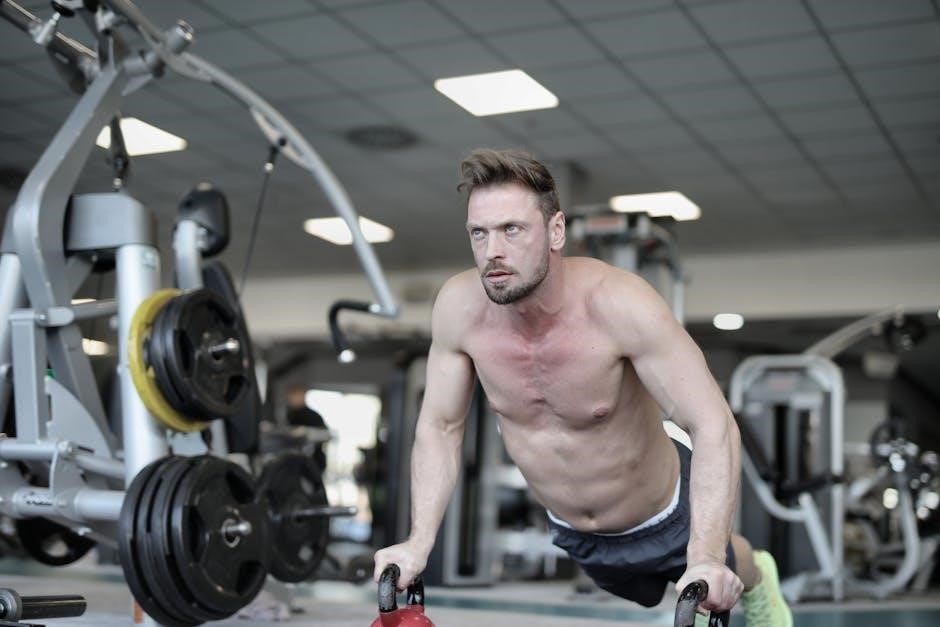
Kettlebell Exercises for Lower Body
PDF workout guides highlight lower body exercises like kettlebell swings, goblet squats, lunges, and Romanian deadlifts, building strength and endurance.
These movements effectively target glutes, hamstrings, and quads for a comprehensive lower body workout.
Kettlebell Swings
Kettlebell swings are a cornerstone of many full-body workout PDF programs, celebrated for their high-intensity, low-impact nature. They are a ballistic exercise, meaning they involve explosive movement, engaging multiple muscle groups simultaneously.
Proper form is crucial; the power should originate from the hips, not the arms, creating a dynamic movement that works the posterior chain – glutes, hamstrings, and lower back – alongside the core and shoulders.
Many PDF guides detail swing variations, from American swings (lifting the kettlebell overhead) to Russian swings (stopping at chest height). They are excellent for improving cardiovascular fitness, building strength, and burning calories efficiently. Mastering the swing is often a foundational step in progressing to more complex kettlebell exercises.
Consistent practice, guided by a well-structured program, yields significant results.
Goblet Squats
Goblet Squats, frequently featured in full-body kettlebell workout PDFs, are a fantastic variation of the traditional squat, offering unique benefits. Holding the kettlebell close to your chest – in the “goblet” position – encourages a more upright torso and deeper squat depth.
This positioning naturally promotes better form, making it an excellent exercise for beginners learning proper squat mechanics. It heavily engages the quads, glutes, and core, building lower body strength and stability.
Many PDF programs incorporate goblet squats as a foundational movement, often included in 3-week or 5-day plans. They are easily scalable by adjusting the kettlebell weight, making them suitable for all fitness levels. Proper execution is key to maximizing benefits and preventing injury.
Focus on controlled movements throughout the exercise.
Kettlebell Lunges
Kettlebell Lunges are a staple in many full-body kettlebell workout PDF guides, effectively targeting the legs and glutes while improving balance and coordination. Holding a kettlebell in one or both hands during a lunge increases the intensity and challenges core stability.
Variations include forward lunges, reverse lunges, and walking lunges, each offering a slightly different emphasis. PDF programs often integrate kettlebell lunges into circuits or as part of a longer lower-body sequence.
They are a highly functional exercise, mimicking real-life movements and building unilateral strength – strength on one side of the body at a time. Proper form is crucial; maintain an upright torso and controlled descent. Adjusting the kettlebell’s weight allows for progressive overload.
Focus on controlled movements throughout the exercise.
Romanian Deadlifts with Kettlebell
Romanian Deadlifts (RDLs) with a kettlebell, frequently detailed in full-body workout PDFs, are excellent for strengthening the posterior chain – hamstrings, glutes, and lower back. This exercise emphasizes a hip hinge movement, promoting proper form and preventing lower back strain.
Holding the kettlebell in front of the thighs, slowly hinge at the hips, keeping the back straight and the core engaged. Lower the kettlebell towards the ground, feeling a stretch in the hamstrings. Many PDF guides suggest starting with a lighter weight to master the technique.
RDLs improve flexibility and build strength essential for functional movements. They are often included in programs alongside swings and squats for a comprehensive lower-body workout. Focus on maintaining a neutral spine throughout the exercise.
Controlled movements are key for optimal results.
Kettlebell Exercises for Upper Body
Kettlebell exercises like push presses, rows, curls, and shoulder presses, often found in PDF workout guides, build upper body strength and endurance effectively.
These movements enhance functional fitness.
Kettlebell Push Press
The Kettlebell Push Press is a powerful, compound exercise frequently featured in full body PDF workout programs, targeting shoulders, triceps, and core simultaneously. It builds explosive power and strength, differing from a strict shoulder press by utilizing a slight dip of the knees to generate momentum.
To perform, hold the kettlebell racked at shoulder height. Dip your knees slightly, then powerfully extend your legs and drive the kettlebell overhead, locking out your arms. Control the descent, returning to the racked position.
Proper form is crucial; maintain a tight core and avoid leaning back excessively. This exercise is often included in 5-day workout plans and HIIT routines for its efficiency and calorie burn. Adjust weight as needed for progression.
Kettlebell Rows
Kettlebell Rows are a cornerstone exercise in many full body PDF workout programs, effectively building back strength and improving posture. They target the lats, rhomboids, and biceps, contributing to a balanced physique and functional movement.
To execute, hinge at the hips, keeping your back straight and core engaged. Hold the kettlebell in one hand, letting it hang towards the floor. Pull the kettlebell upwards towards your chest, squeezing your shoulder blades together.
Lower the weight with control; This exercise is often incorporated into 3-week programs and 5-day plans, promoting muscle endurance and strength. Focus on maintaining a neutral spine throughout the movement for optimal results and injury prevention.
Kettlebell Bicep Curls
Kettlebell Bicep Curls are a valuable addition to full body workout PDF guides, targeting the biceps brachii and brachialis muscles for increased arm strength and definition. They offer a unique challenge compared to traditional dumbbell curls due to the kettlebell’s offset center of gravity.
To perform, stand with feet shoulder-width apart, holding the kettlebell with an underhand grip. Keep your elbows close to your body and curl the kettlebell upwards towards your shoulder, squeezing your biceps at the top of the movement.
Slowly lower the weight back to the starting position. These curls are frequently included in 5-day plans and can be modified for beginners by reducing the weight or repetitions.
Kettlebell Shoulder Press
Kettlebell Shoulder Presses are a powerful exercise often featured in comprehensive full body workout PDFs, effectively building shoulder strength and stability. This movement targets the deltoids, trapezius, and triceps, contributing to upper body power and improved posture.
To execute, hold the kettlebell by the horns close to your shoulder, with your elbow bent. Press the kettlebell straight overhead, fully extending your arm, and maintaining a stable core. Lower the weight slowly and controlled back to the starting position.
Variations include single-arm presses for increased core engagement. These presses are commonly integrated into 3-week programs and HIIT routines, enhancing overall strength and conditioning.

Kettlebell Exercises for Core
Kettlebell workouts, detailed in many PDF guides, effectively challenge the core with exercises like Russian twists, windmills, and Turkish get-ups for stability.
Kettlebell Russian Twists
Kettlebell Russian twists are a fantastic core exercise frequently included in full body kettlebell workout PDF programs. They effectively target the obliques, rectus abdominis, and lower back muscles, promoting rotational strength and stability.
To perform, sit on the floor with knees bent and feet slightly elevated. Hold a kettlebell close to your chest and twist your torso from side to side, tapping the kettlebell near the floor on each side.
Maintaining a straight back and engaging your core throughout the movement is crucial. Beginners can start without weight or with a lighter kettlebell, gradually increasing the resistance as their core strength improves. Many PDF guides suggest incorporating this exercise into circuits for a challenging and efficient workout.
Kettlebell Windmills
Kettlebell windmills are a complex yet highly effective exercise often featured in advanced full body kettlebell workout PDF routines. They demand significant core stability, flexibility, and coordination, working the entire body, particularly the obliques, hamstrings, and shoulders.
Begin standing with feet wider than shoulder-width apart, holding a kettlebell overhead with one arm. Hinge at the hips, keeping your back straight and eyes focused on the kettlebell, and lower your body towards the opposite foot.
Maintain a straight arm throughout the movement and return to the starting position. This exercise requires proper form to prevent injury; PDF guides often emphasize mastering the movement with lighter weights before progressing.
Kettlebell Plank Drags
Kettlebell plank drags are a challenging core exercise frequently included in full body kettlebell workout PDF programs, designed to enhance stability and anti-rotation strength. Starting in a high plank position with a kettlebell positioned to one side, the exercise involves dragging the kettlebell across the body to the other side, maintaining a rigid plank.
This movement requires intense core engagement to prevent hip rotation and maintain a straight line from head to heels. It’s a fantastic way to target the obliques, transverse abdominis, and lower back.
PDF guides often recommend starting with a lighter kettlebell and focusing on controlled movements to ensure proper form and prevent lower back strain.
Turkish Get-Ups
Turkish Get-Ups are a complex, full-body exercise often highlighted in full body kettlebell workout PDF guides, demanding coordination, strength, and stability. Beginning lying on your back with a kettlebell extended overhead, the exercise involves transitioning through multiple positions – rolling to one side, posting up on one hand, moving to a lunge, and finally standing.
This movement engages nearly every muscle group, improving shoulder stability, core strength, and overall body control. PDF resources emphasize mastering each segment of the get-up before adding weight.
Progressive overload is key; start with no weight, then a light kettlebell, focusing on smooth, controlled transitions. It’s a cornerstone of functional fitness.
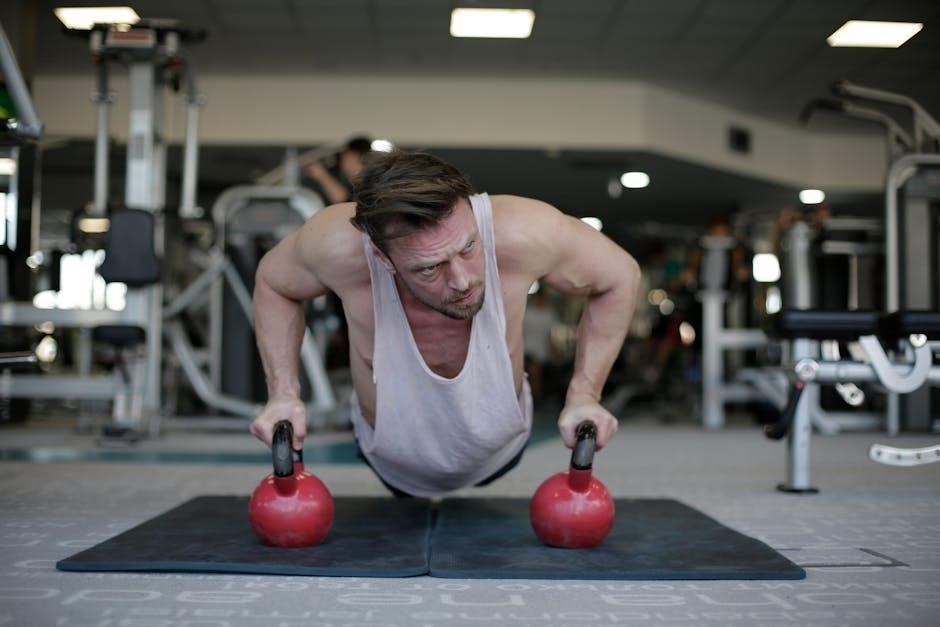
Full Body Kettlebell Workout Programs
Full body kettlebell workout PDF resources offer structured plans, from 3-week programs focusing on swings and get-ups, to 5-day plans for weight loss.
HIIT options are also available.
3-Week Kettlebell Program Overview
This 3-week kettlebell program, often found as a PDF download, is designed to build full-body strength and endurance progressively. The initial week focuses on mastering fundamental movements like the kettlebell swing, goblet squat, and basic Turkish get-up, emphasizing proper form and technique. Workouts are typically shorter, prioritizing learning and muscle activation.
Week two increases the volume and introduces more complex exercises, such as kettlebell lunges and rows, challenging your stability and coordination. Expect longer workout durations and a greater emphasis on cardiovascular fitness. The final week combines elements from the previous weeks, incorporating higher intensity intervals and advanced variations to maximize results.
Core work is integrated throughout the program, utilizing exercises like Russian twists and windmills. The program’s structure allows for adaptation based on individual fitness levels, making it suitable for both beginners and intermediate users.
5-Day Kettlebell Workout Plan
A typical 5-day kettlebell plan, often available as a PDF, structures workouts for comprehensive full-body conditioning. Day one might focus on lower body – swings, goblet squats, and lunges – building foundational strength. Day two shifts to upper body, incorporating push presses, rows, and shoulder presses for muscle development.
Day three is dedicated to core stability, featuring Russian twists, windmills, and plank drags. Day four combines elements from previous days in a circuit-style workout, enhancing cardiovascular fitness. Finally, day five could be a dedicated HIIT session utilizing kettlebell swings and burpees for maximum calorie burn.
Rest days are crucial for recovery. Each workout typically includes a warm-up and cool-down, and weight selection should be adjusted based on individual fitness levels. This plan aims for balanced muscle engagement and improved functional strength.
Kettlebell HIIT Workout
Kettlebell High-Intensity Interval Training (HIIT), frequently detailed in PDF workout guides, is a powerful method for fat loss and cardiovascular improvement. A typical session alternates between short bursts of intense exercise and brief recovery periods.
A common structure involves 30-60 seconds of work, such as kettlebell swings, followed by 15-30 seconds of rest. Other exercises include burpees with a kettlebell, high pulls, and alternating lunges. These circuits are repeated for 20-30 minutes.
HIIT maximizes calorie expenditure and boosts metabolism. Many PDF programs suggest 2-3 HIIT sessions per week, combined with strength training. Proper form is vital to prevent injury, and modifications can be made for different fitness levels.

Workout Variations & Progression
PDF guides often detail how to adjust kettlebell weight and modify exercises for beginners, while advanced techniques challenge experienced users for continuous progress.
Adjusting Weight for Progression
Progressive overload is key to continued improvement with kettlebell training, and adjusting the weight is a primary method. Many full body kettlebell workout PDF guides emphasize starting with a manageable weight, focusing on proper form before increasing the load.
Beginners should master movement patterns with lighter kettlebells, gradually increasing the weight as strength and technique improve. A general rule is to increase weight only when you can comfortably perform all repetitions with good form. Small increments are best – avoid large jumps that compromise technique.
PDF programs often suggest specific weight ranges for different exercises and fitness levels. Listen to your body; don’t force progression if you experience pain or fatigue. Remember, consistent, controlled progression is more effective than rushing to heavier weights.
Modifying Exercises for Beginners
Full body kettlebell workout PDF resources frequently highlight the importance of modifications for beginners. Starting with scaled versions of exercises ensures proper form and prevents injury. For example, kettlebell swings can be modified by reducing the range of motion or performing American swings (between the legs) initially.
Goblet squats can be simplified by using a lighter kettlebell or performing box squats for added stability. Lunges can be modified by shortening the stride or using a chair for balance. PDF guides often demonstrate these modifications visually.
Prioritize mastering the movement pattern before adding weight or complexity. Don’t hesitate to regress to easier variations if needed, focusing on controlled movements and engaging the correct muscle groups.
Advanced Kettlebell Techniques
Full body kettlebell workout PDF programs for advanced users often introduce complex movements beyond the basics. These include advanced swing variations, single-leg deadlifts with heavier weights, and more challenging core exercises like advanced windmills or complex Turkish get-up flows.
Flow drills, combining multiple kettlebell exercises seamlessly, are common in advanced routines. Mastering these requires significant strength, coordination, and body awareness. PDF guides will detail proper technique and progressions.
Consider incorporating plyometric kettlebell exercises, like jump squats or snatches, to enhance power and explosiveness. Always prioritize form and control, even when increasing intensity.

Cool-down and Recovery
PDF workout plans emphasize static stretching and foam rolling post-workout to reduce muscle soreness and improve flexibility, aiding in optimal recovery.
Static Stretching
Static stretching is a crucial component of cool-down routines following a full body kettlebell workout, often detailed within PDF guides. Holding each stretch for 20-30 seconds allows muscles to lengthen and recover, improving flexibility and reducing post-exercise soreness.
Focus on major muscle groups utilized during the workout, including hamstrings, quads, glutes, chest, shoulders, and back. Examples include hamstring stretches, quad stretches, triceps stretches, and shoulder cross-body stretches.
Proper static stretching enhances range of motion, prevents muscle imbalances, and supports long-term joint health. Integrating these stretches, as prescribed in many workout PDFs, is vital for maximizing the benefits of kettlebell training and minimizing the risk of injury.
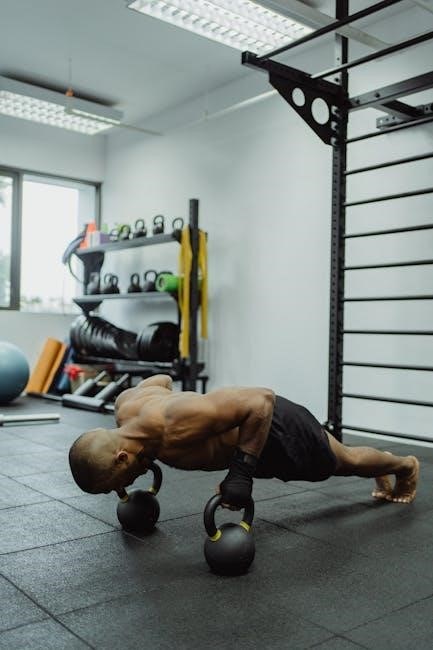
Foam Rolling Techniques
Foam rolling is a self-myofascial release technique, often included as a recovery method in full body kettlebell workout PDFs. It helps alleviate muscle tension, improve blood flow, and enhance flexibility post-workout. Target major muscle groups like quads, hamstrings, glutes, back, and shoulders.
Apply moderate pressure and slowly roll over each muscle group for 30-60 seconds, pausing on tender spots. Techniques include broad sweeping motions and pinpoint rolling.
Incorporating foam rolling, as detailed in many recovery sections of workout PDFs, complements static stretching, promoting faster muscle recovery and reducing the risk of delayed onset muscle soreness (DOMS). Consistent foam rolling supports optimal performance and injury prevention.

Resources & Further Learning
Explore numerous PDF guides and thriving online communities for deeper kettlebell knowledge, workout plans, and technique refinement.
Access 52 kettlebell exercises and detailed programs to enhance your full-body training journey.
Recommended Kettlebell PDF Guides
Numerous downloadable PDF guides offer structured kettlebell workout programs for all levels. Many focus on full-body routines, incorporating exercises like swings, goblet squats, and Turkish get-ups, providing detailed instructions and progressions.
Look for guides that emphasize proper form and safety, crucial for preventing injuries. Some PDFs specialize in specific goals, such as fat loss, muscle building, or improved conditioning. A 30-day kettlebell swing workout PDF is popular for rapid fat shredding, while others present comprehensive 3-week programs;
Consider resources detailing 52 kettlebell exercises, offering a vast library to build varied routines. These guides often include workout plans, allowing you to tailor your training to your individual needs and fitness level. Always prioritize guides from reputable sources to ensure accuracy and effectiveness.
Online Kettlebell Communities
Engaging with online kettlebell communities provides access to a wealth of knowledge, support, and workout ideas, often complementing PDF guides. These platforms allow users to share routines, ask questions, and receive feedback on form, enhancing learning and motivation.
Many communities feature dedicated threads for full-body kettlebell workouts, with members posting their favorite programs and modifications. You can find discussions on 3-week plans, HIIT routines, and technique tips for exercises like swings and Turkish get-ups.
These forums are invaluable for discovering new exercises, troubleshooting challenges, and staying inspired. Sharing experiences and learning from others fosters a supportive environment, accelerating progress and ensuring safe, effective training. Active participation can significantly enhance your kettlebell journey.



About the author